
http://www.baltimoresun.com/features/bal-to.minister27apr27,1,7975999.story
Fire without brimstone
Brian McLaren preaches
tolerance and environmentalism, making him one of the country's more
unusual yet influential evangelicals.
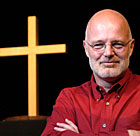
By Abigail Tucker, Sun Staff, April 27, 2005
This is an especially happy church. Laughing congregants arrive in
jeans, clutching small children and
gigantic coffee mugs. When the
children are comfortable and the coffee finished, and the rock band
that opens the Sunday morning service finds its groove,
the swaying
people reach their hands upward,
as though expecting a high-five from
on high.
At the very least, they might get a bear hug after the service
from Brian McLaren, the man at the center of Cedar Ridge Community
Church's ebullience, and, some would say, one of the most powerful
evangelical preachers in America today. He stands in the middle of the
sanctuary, his bowed head bald as a monk's, a smile on his face.
The people in the audience smile back -- even though they know their
pastor is leaving them.
This winter, McLaren announced that he is stepping down as senior
pastor for a more minor role in the Montgomery County church that has
grown so large that off-duty police officers direct traffic flowing out
of the parking lot most Sundays. Instead of preaching the gospel almost
every week, the North Laurel resident will be traveling to seminaries
and religious summits across America and the world, explaining his
vision of Christianity in the new century.
The church he founded will have to learn to survive without him.
McLaren's celebrity loomed large even before February, when Time
magazine named him one of the 25 most influential evangelicals in
America, alongside the likes of Billy Graham and Rick Warren, who wrote
The Purpose-Driven Life. At 48, McLaren is the unofficial leader of the
"emergent church" movement, which emphasizes environmentalism and
racial and sexual tolerance, while distancing itself from the social
conservatism of the religious right.
The author of seven books and the co-author of two more, McLaren is
modest about his role.
"I'm having some influence over younger leaders and future leaders," he
admits.
"He's the guru," says Tony Campolo, a professor of sociology at
Eastern University in St. Davids, Pa., who co-authored a book with
McLaren. "Word got around that there was a guy with something new to
say who was interesting and easy to understand. A lot of evangelicals
who do not buy into the politics of the religious right said, 'Hey,
we've got a spokesperson here.'"
But many Christians object to McLaren's message, particularly his
permissive attitude toward issues like abortion, which -- in an
evangelical landscape where a pro-life stance is practically a given --
McLaren opposes but doesn't openly condemn. More generally,
conservatives complain that this feel-good faith drains the content out
of Christianity.
"If you take his theology to its logical conclusion, it would
destroy the Christian church, or Christianity as we understand it,"
said Mark Galli, the managing editor of Christianity Today.
Some evangelical groups have rejected McLaren's liberalism.
Recently, the Kentucky Baptist Convention withdrew its invitation to
him to speak at a February conference because his position "diverges
too greatly to be appropriate," the convention's director said.
More often, though, McLaren's views incite curiosity and debate --
which even critics like Galli say is a good thing -- and his schedule
is packed. Almost every week brings a speaking engagement.
But long before he led a movement, McLaren led a church.
The seeds of Cedar Ridge were planted in his College Park
apartment in the early 1980s, when he was a graduate student and
aspiring English professor at the University of Maryland.
By his early 20s, McLaren had already dabbled in Christian formats
as disparate as the hippie-dominated Jesus movement and the traditional
Episcopal church. Raised in Rockville in an extremely conservative
church, he started questioning religion as a young man.
His doubts had as much to do with Joni Mitchell and James Taylor
as Jesus Christ. A consummate musician, McLaren found it hard to love a
God who didn't even like rock 'n' roll. After late Saturday nights
spent at teen dance halls, he fidgeted in the pews on Sunday mornings,
thinking, "If this stuff about God is true, I'm getting in a lot of
trouble," McLaren recalled. "And if it's not true, who cares."
But he couldn't stop caring.
"It just mattered to me," said McLaren. "I prayed a lot. I'd be
praying, 'Are you there? Are you real?' It mattered to me."
He was still praying years later when he started his living room
Bible study in College Park with a few dozen people, mostly fellow
students. These were young intellectuals dismayed by the mounting
conservatism of the evangelical community, who wanted a close
relationship with God without the constant threat of condemnation.
"We just tried to create a kind of a safe space," said McLaren.
Soon that safe space wasn't big enough. The nondenominational
group moved to a larger living room, where it started meeting on
Sundays, then to a Hyattsville middle school and progressively larger
auditoriums. The church was itinerant throughout the late '80s and
early '90s.
"If you could find us, you could worship with us," McLaren said.
By 1995, the church had enough support to buy a 63-acre farm in
Spencerville, which opened its doors a few years later and now, on an
average Sunday, attracts close to 1,000 members and visitors.
In starting the church, McLaren -- who is not an ordained minister
-- targeted "people who are spiritually seaarching but don't get the
whole church thing," he said. "I felt we could develop a church for the
people who feel alienated," or, as he calls them, "the unchurched." His
evangelism is infused with progressive politics because, he said,
"being anti-homosexual, pro-war, pro-rich and anti-environment is a
very disturbed reflection of Jesus."
Instead, McLaren preaches a feel-good Christianity far removed
from his fire-and-brimstone upbringing. To the horror of many
evangelicals, he questions the idea of hell and claims that, through
human love, heaven can be lived on earth.
The growing church generated interest in Maryland's 12-step world,
and the unusual number of recovering alcoholics who attend is the
reason Cedar Ridge offers Communion with grape juice instead of wine.
The church is ethnically diverse and draws Republicans and Democrats in
equal measure. Purple hair and piercings are not frowned upon.
Shannon D. Brown of Dundalk started attending two years ago. The
28-year-old, who uses a wheelchair, was frustrated with her previous
church, where members trumpeted the Golden Rule but didn't offer her a
ride to services. Although Cedar Ridge is farther away, she said, it's
a much more accommodating community.
"And not just physically," she said. "It's the people, and how
accessible they are. It's Brian, and how open he is."
Yet McLaren never intended to be a pastor, particularly of a
congregation approaching megachurch proportions. His first love was
academia, and after he got his master's degree from the University of
Maryland in 1981, he taught technical writing and other classes at his
alma mater and elsewhere.
But by 1986, the church that would become Cedar Ridge blossomed
under his leadership, and he abandoned his academic career for
full-time ministry. Much of the next decade was devoted to developing
the church.
In the late 1990s, though, with the congregation secure in its new
home, McLaren's intellectual life came full circle, and he began
writing books. In 2001, his A New Kind of Christian: A Tale of Two
Friends on a Spiritual Journey became a surprise best seller among
evangelicals.
The book was a hit because "it was completely unoriginal," McLaren
said. "It put into words what people had already been thinking, and
they were relieved to learn they weren't the only ones."
A New Kind of Christian also articulated the philosophy of the
"emergent church," a term that McLaren and others use to describe a
network of young church leaders who, in the late 1990s, became
concerned about the lack of religious participation among 18- to
35-year-olds.
McLaren and the others decided that the Gen-Xers weren't lazy but
rather represented a cultural sea change. Coming of age in the
aftermath of the Cold War led this generation to question moral
absolutism and dogmatic religion, the emergent gurus argued. Most
evangelical churches weren't feeding their hunger for a nontraditional
Christianity, creating an opening for pastors like McLaren, who believe
that a more relaxed theology addresses the ambiguities of modern life
while remaining true to the gospel.
McLaren's critics are skeptical.
McLaren is "more into asking questions than charting a positive
path," said Galli, of Christianity Today. "All his ideas are
experiments, forays, just ideas."
Yet some of those ideas have found concrete expression at Cedar
Ridge, in the Sunday services that embrace popular culture by
synthesizing rap music with Bible readings, and on the church property
itself, which is scattered with beehives and bluebird houses that speak
to the congregation's burgeoning environmentalism.
And, although McLaren, in his new role as teaching pastor, will
still preach some Sundays, perhaps the strongest testimony to the
success of his ministry is church members' belief that they will be
able to survive without his constant presence.
"We love Brian, and we will miss him as a person, his intellectual
aspect, how smart he is, his ability to cut through to the heart of
things," said Betsy Mitchell Henning of Laurel, who joined the church
in 1991 and is now the director of liturgical arts. "But if the
Martians abducted him tomorrow, Cedar Ridge would find a way to love
people and glorify God."
And McLaren isn't alone in reaching out to help the larger world.
In recent days, ailing churches -- a Methodist congregation in
Baltimore, a Baptist church in Bethesda -- have requested help from
Cedar Ridge, and delegations have been dispatched to boost attendance
and energy levels. Apparently, not only are members feeling strong
enough to share their pastor, but they're ready to share themselves.
Copyright © 2005, The Baltimore Sun